
"Ready for front-line": "Game-changer" drones rolled out on Royal Navy ops after HMS Prince of Wales trials

Advanced drone systems which have been trialled in drug-busting missions have been declared operational for the Royal Navy.
Front-line operations will now be bolstered with Malloy T-150 and Peregrine systems on a widespread basis. After two years of trials and development, the Malloy aircraft will be used to carry ammunition, weaponry, food, and medical supplies, to Royal Marines Commandos operating in harsh environments.


These devices are currently being used on a UK Carries Strike Group deployment for the first time, with aircraft ferrying supplies to and from HMS Prince of Wales. A surveillance and reconnaissance, the Peregrine mini helicopter, has also been rolled out after trials with HMS Lancaster.
Brigadier Chris Haw, Head of the Commando Forces Programme, said: “The UK Commando Force continues to be at the vanguard of operational change in embedding digital and autonomous systems into the way we fight. The introduction of logistic drones represents a significant expansion in the Commando Force’s use of un-crewed Aerial Systems, beyond those already in-service for surveillance/reconnaissance, and importantly reduces the risk to personnel during tactical re-supply.
“Tested in operationally representative conditions, and developed in close collaboration with Malloy, the equipment and operators have made considerable progress. The T-150 has great potential for broader use-cases as we have recently seen in operational theatres and on the Carrier Strike deployment.”
Drone operators from 700X Naval Air Squadron and Commando Logistic Regiment have put the Malloy T-150s through a demanding set of tests and exercises. Harsh environments provided the backdrop for these tests, from the freezing Arctic to the Indian Ocean.
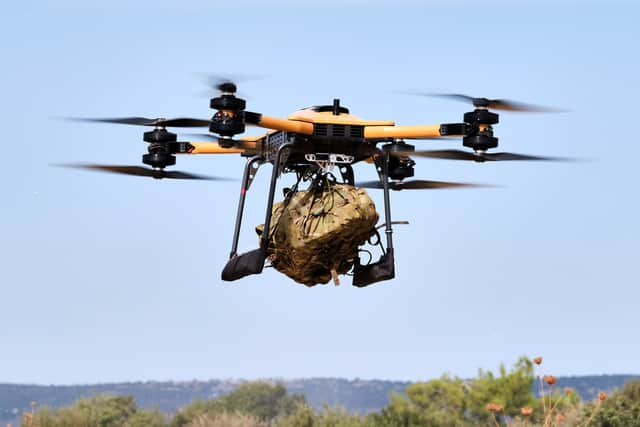
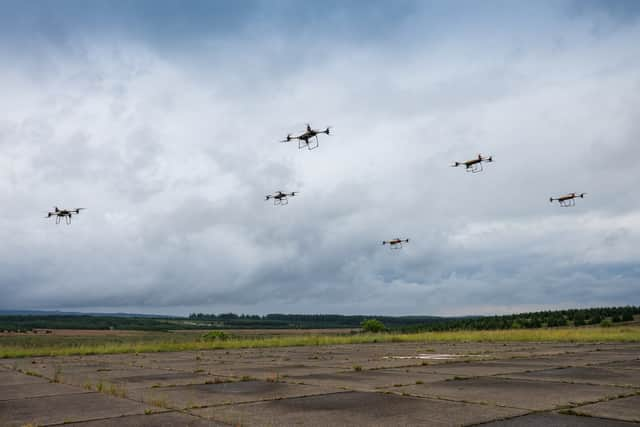
The Malloy was able to bring supplies over complex terrain, reaching places which otherwise would have been unviable. With eight rotor blades – each around two feet in length – an endurance of up to 40 minutes, top speed of 60mph, and the ability to lift up to 68kg, the Malloy is set to be a powerful platform for years to come.
Neil Appleton, CEO Malloy Aeronautics, said: “The UK Release to Service of our T-150 platform is a milestone we’re incredibly proud to be a part of. As a multi-role UAS, the T-150 can be used for Replenishment at Sea one day and resupplying deployed Royal Marines Commandos the next. It’s a game-changer for the modern battlefield and we are proud to deliver this capability to those who need it most.
“We’ve partnered with the UK Armed Forces throughout this programme, from the Royal Marines Commando Force to wider Ministry of Defence organisations to deliver this capability at pace, including training and in service support. We welcome this further strengthening of our partnership with the UK armed forces and remain committed to expanding the capability of our multi-role solutions for the UK.”
Peregrine has been used on several of HMS Lancaster’s missions in the Middle East. It’s equipped with a powerful radar which works in all weathers day or night, with the ability to track and target threats in maritime and coastline areas.
Captain Dave Gillett, Head of Navy Develop’s Maritime Aviation & Carrier Strike, added: “The introduction of Peregrine into service is a game-changer for our surface fleet. Its successful deployment with HMS Lancaster shows how uncrewed systems can deliver real operational advantage, extending our surveillance reach and enhancing our decision-making in theatre.
“With the integration of the IMaster radar, Peregrine provides exceptional surveillance capability and is a vital step for wider Maritime Aviation Transformation, ensuring the Royal Navy remains at the forefront of innovation in naval aviation.”