
'First-of-its-kind' quantum clock experiments test new technology with Royal Navy ship XV Patrick Blackett

The Royal Navy is looking to advance its technological capabilities to deal with the threats of tomorrow
Advanced quantum clock technology has been tested by Royal Navy experts in a bid to deal with future threats.
Military maritime radars were used to scope out positions and test if this can be passed on at a quicker rate. Personnel in the Disruptive Capabilities and Technologies Office worked with SAAB and quantum technology experts Aquark Technologies to test the firm’s AQlock.

Matthew Aldous, Timing Lead at Aquark Technologies, added: “This trial is a milestone in the development of UK sovereign quantum technology and a UK first-of-its-kind military application of a UK atomic clock.
“It’s the first known time that a pair of British built cold atom systems has been deployed in answer to a genuine defence challenge, and we’re very proud to work with Saab and the Royal Navy in this way.”
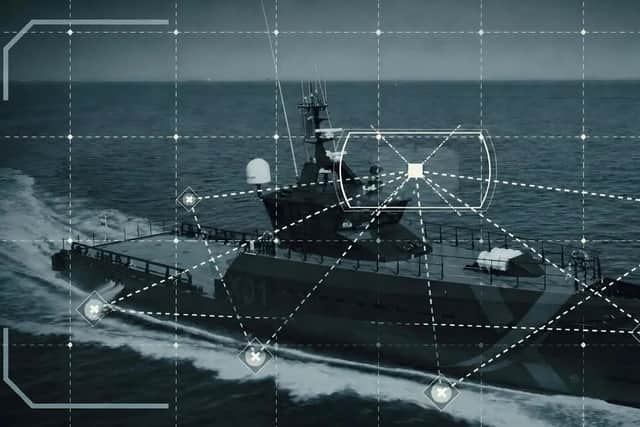
Not reliant on traditional timing, the cold atom clock can provide more accurate information at a faster rate. These atoms are slowed down at very low temperatures and detect any changes by comparing the frequency of the clock to them, allowing for ultra-precise timing. The trials utilised the Royal Navy’s experimentation ship XV Patrick Blackett, based in Portsmouth, and Portsdown Technology Park.
Having previously been tested aboard the P2000 Archer-class vessel HMS Pursuer, the latest trials saw the clock work with Saab’s Giraffe 1X radars at Saab and Qinetiq sites. XV Patrick Blackett, and at the Ministry of Defence’s Defence Science and Technology Laboratory, acted as a network rebroadcast nodes.
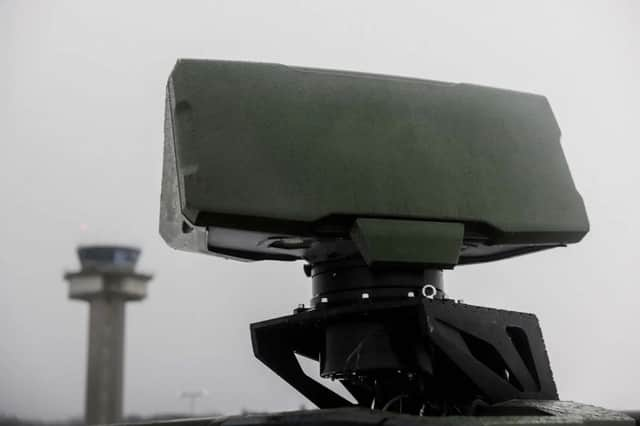
Two quantum clocks were brought to two locations, where they provided radar information on Portsdown Hill. These trials also mimicked the spoofing or jamming of navigation systems. Given that the Royal Navy is pushing towards a hybrid force of autonomous ships, disrupting communication systems will become a more common tactic used by adversaries.
The Giraffe 1X radar operators, using a network spanning several pieces of software and hardware, were able to observe these manipulations of their system including deliberate misalignment of timestamps.
Andy Fraser, group managing director at Saab UK, said: “This trial is a great example of how collaboration can accelerate innovation. By combining quantum timing technology with Saab’s advanced Giraffe 1X radar system, we have demonstrated a practical capability that could help customers continue to operate effectively when it matters most.”