
"Disappointing return" for HMS Prince of Wales and HMS Queen Elizabeth F-35 fighter jets with "serious gaps"

The mammoth programme for Britain’s carrier fighter jets has been hit with delays, shortages of equipment and a lack of personnel, the public spending watchdog has said.
The F-35 Lightning stealth jet used by the RAF on HMS Prince of Wales and HMS Queen Elizabeth has come under fire by the National Audit Office (NAO). In a Value For Money report published today (July 11), the aircraft is branded as “significantly superior” to previous variants, but marked a “disappointing return” compared to initial plans set by the MoD.
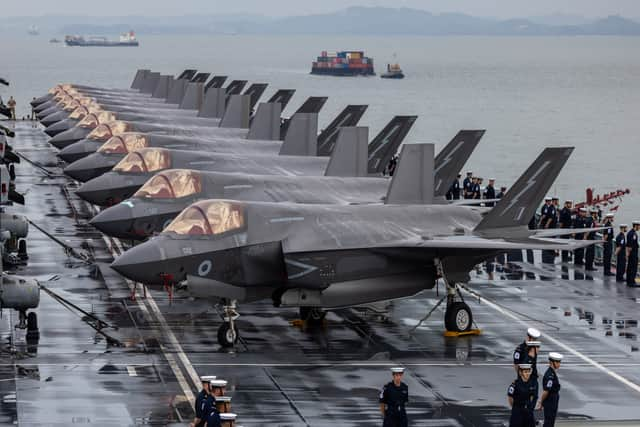

The F-35 is primarily built by US companies, including Lockheed Martin which has a presence in Havant. Despite this, roughly 15 per cent by value of each aircraft is manufactured in the UK, generating roughly £22bn in contracts for British firms.
The report said: “Due to failings of both the MoD and the global programme, the level of overall UK F-35 capability is currently lower than the MoD intended it would be by now at the time of its 2013 business case, and will be for several years.” It added: “In our view, the capability achieved for the estimated £11 billion spent to date is a disappointing return so far compared with MoD plans, even if other programme benefits have been significant”.
How far away is the programme from being achieved?
Currently, 37 F-35B aircraft are in service out of the planned total of 138. Out of these, 12 of these will be the F-35A counterpart, with aircraft being able to carry nuclear weapons. They are expected to save the government 25 per cent per aircraft, but cannot be used on HMS Prince of Wales and HMS Queen Elizabeth.
The jets are projected to be in service until 2069 at a £71bn whole life cost, the NAO estimates. Its report said the “mission capable rate” – the ability of an aircraft to perform at least one of its seven possible required missions – was approximately half the MoD’s target. The “full mission capable rate” – an aircraft’s ability to carry out all its required missions – was only around a third of the target.
Specific figures have not been disclosed for security reasons. Flying hours have been below the requirements for RAF pilots. The report said: “The MoD’s short-term affordability decisions and serious global programme delays have hindered the delivery of aircraft and other supporting capability.”
The NAO added that “major personnel shortages” across the F-35 force and “serious gaps” in engineering roles. Delivery of the first phase of 48 aircraft, due by the end of April 2026, was behind schedule partly for financial reasons and partly because of global programme delays, they said.
A Ministry of Defence (MoD) said: “The National Audit Office’s report rightly recognises the world-class capabilities of the F-35 fighter jet, as well as its significant economic benefits – including £22bn of work for UK companies, creating thousands of jobs. The programme continues to operate within its approved budget and the UK will have two full squadrons of F-35 fighter jets ready for deployment by the end of this year. We also recently announced we will purchase 12 F-35As, supporting 20,000 jobs in the UK, and join Nato’s dual capable aircraft nuclear mission.”