
Iran: What Royal Navy warship HMS Dragon may face if she goes to Strait of Hormuz, from mines to drone strikes

Tearful families waved goodbye to HMS Dragon as she left Portsmouth bound for the eastern Mediterranean.
The Royal Navy Type 45 destroyer sailed past The Round Tower in Old Portsmouth yesterday afternoon (March 10). Originally planned to conduct a maintenance period and then be in charge of Nato’s Standing Maritime Group 1, the warship was supplied and reactivated within six days.
Critics - including those in Cyprus - have suggested that it has taken too long for the vessel to depart, while the defence secretary believes it has taken a monumental effort to deploy at short notice. More than anything, the deployment has outlined the desperate need to bolster the Royal Navy fleet and retain a presence in the Mediterranean and Middle East.
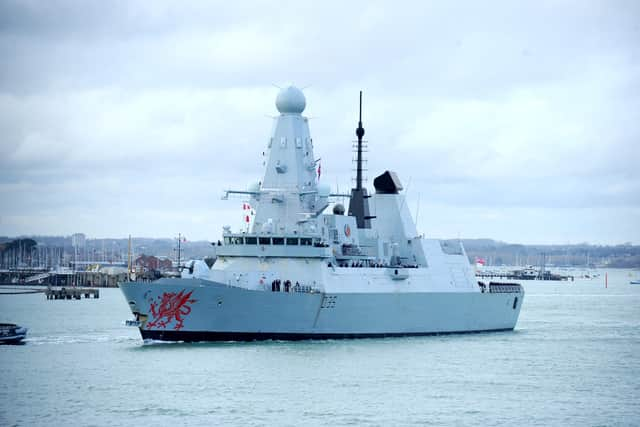

HMS Dragon was deployed to Cyprus after RAF Akrotiri was struck by a kamikaze drone, with other un-crewed systems intercepted. The Ministry of Defence (MoD) previously confirmed that a Shahed-like drone was used in the strike, but it did not originate from Iran itself. The attack is believed to have come from an Iranian-affiliated militia in Lebanon or western Iraq. Depending on her possible duties and tasks, HMS Dragon’s deployment can change in an instant.
British armed forces state of play
HMS Dragon, crewed by roughly 200 personnel, was resupplied at Portsmouth’s Upper Harbour Ammunitioning Facility (UHAF) with anti-strike supplies. She is equipped with Sea Viper missiles and advanced radar. The destroyer is expected to be joined by the support ship RFA Lyme Bay, who will provide medical and aviation support amid the possibly of helping citizens evacuate from Lebanon amid burgeoning hostilities between Israel and Iranian proxy Hezbollah.
They will be joined by Wildcat helicopters equipped with Martlet missiles designed to target drones and other un-crewed aerial systems. Merlin Mk2 surveillance aircraft have already been deployed to RAF Akrotiri. RAF Typhoons and fighter jets are already patrolling airspace in the Mediterranean and parts of the Middle East, shooting down various drones.
What is going on in the Middle East right now? Iran shipping strikes and US-Israeli actions
Under the guidance of Tehran’s new Supreme Leader, Mojtaba Khamenei - son of killed Ayatollah Ali Hosseini Khamenei - Iran is targeting cargo ships in the Strait of Hormuz. Situated between the Persian Gulf and the Gulf of Oman, the strategic waterway is vital by heading east towards the Indian Ocean. Roughly one fifth of all oil is shipped through this passage.
Strikes have targeted oil fields and refineries in a bid to put pressure on the US and Israel to end the attacks. A Thai-flagged cargo ship was attacked in the Strait of Hormuz, with 20 of 23 crew members rescued by Oman’s navy. The UK Maritime Trade Operations (UKMTO) said three cargo vessels have been hit by unknown projectiles in the strait.

The Japanese-flagged vessel One Majesty, which has been left with a 10cm hole after an attack roughly 29 miles north of Ras Al Khaimah, United Arab Emirates. A third ship, the Marshall Islands-flagged bulk carrier Star Gwyneth, was also hit by a projectile from an unknown source around 57 miles north of Dubai. Strikes also continuing to hit Lebanon’s capital Beirut. Over 700,000 people have been displaced from their homes by Israeli evacuation orders.
What HMS Dragon may be tasked to do if she’s deployed to the Middle East?
Britain’s stance has been to play a defensive role while the conflict unfolds. Prime minister Sir Keir Starmer reiterated this stance while attacking the leader of the opposition, Conservative Kemi Badenoch, during Prime Minister’s Questions today (March 11) - claiming she committed “the mother of all U-turns” by retreating from her previous stance of the UK needing to be involved in the initial US-Israeli strikes.
The Royal Navy said HMS Dragon will be tasked with safeguarding British assets and interests. She will be patrolling the waters around Cyprus and RAF Akrotiri, keeping a close eye out for drones and other aircraft. If RFA Lyme Bay is used in evacuation operations, the destroyer will safeguard the Bay-class auxiliary dock landing ship and Royal Fleet Auxiliary sailors.
HMS Dragon may be asked to head to the Strait of Hormuz and the Red Sea, reminiscent of HMS Diamond’s exploits there between December 2023 and June 2024. Iranian-backed Houthi rebels in Yemen have been known to target merchant shipping in the region with drones and missiles.
As reported in The Guardian, Iran has started to lay mines in the strait in recent days. Roughly a dozen have been placed so far, with the capability to sow hundreds more. The US military said it has attacked and destroyed 16 Iranian mine-laying vessels.
The Royal Navy has a mine countermeasure vessel in the Gulf, HMS Middleton, with the force also developing autonomous systems to target underwater explosives. It’s unlikely that HMS Dragon will be deployed in the vicinity of mines, given the alternative capabilities available.
Forces News reports that Iran has a stockpile of between 2,000 to 6,000 mines. These are a mix of domestically built stock, as well as equipment from China, Russia and North Korea. Explosives are a mix of drifting mines that float with the current, contact mines that are anchored to the seabed by cable and detonated when a ship hits the horns on the explosive, bottom mines that sit on the seabed and activated by trigger mechanisms, and other variations.