
Poignant D-Day memorial garden at Stokes Bay in Gosport unveiled after years of work, honouring WWII veterans

A war memorial garden honouring those who served on D-Day has been unveiled to the public after years of hard work and dedication.
Veterans and members of the public flocked to the monument in Stokes Bay near Gosport just after 11am this morning (June 5). A formal dedication service was held to mark the occasion, conducted by the Dean of Gosport Rev Dr Paul Chamberlain. Guests of honour and civic dignitaries joined them.
The passionate group of volunteers at the Gosport D-Day Fellowship have been battling for years to acquire planning permission and appropriate licences. The ground at the proposed site next to Stokes Bay Sailing Club was dedicated last year. Members have spent the past two weeks putting together the final touches to the five-year project.


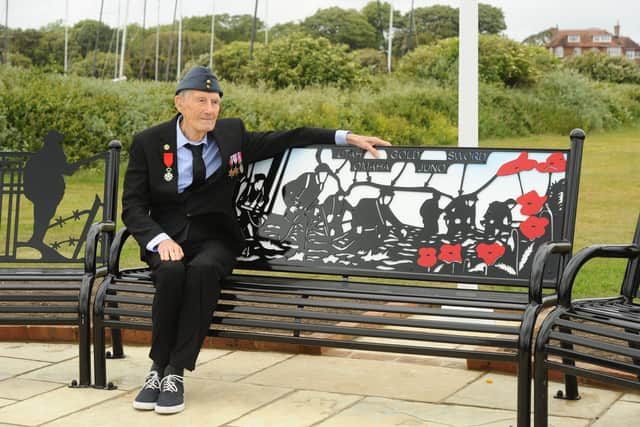
The memorial depicts the role that Gosport played in Operation Neptune and Overlord, on June 6, 1944. Its centrepiece - a lump of granite taken from a casemate during renovations of Fort Gilkicker - is surrounded by five metal benches representing the beaches invaded during Operation Overlord.
The centrepiece was unveiled by a 100-year-old D-Day veteran, Albert Westgate. Mr Westgate, of Waterlooville, is one of a very small number of former military personnel who were alive in June 1944, some 81 years after the Allies assembled the largest-ever amphibious invasion force in history - liberating Europe from Nazi Germany.

Jilly Salvat, who has driven the project since the death of the Fellowship’s founder Malcolm Chapman, was joined by supporters of the appeal at the site on VE Day, last month. They honoured the memory of the thousands of soldiers, sailors and air crew who had left Gosport in the hours leading up to D-Day. Many of them never returned.
Speaking ahead of the ceremony, she said: “It has been a very long road from the original plans envisaged by our late founders Malcom Chapman and Tony Belben, who created the Gosport D-Day Fellowship back in 2011.
“Having had to scale back the scheme from what was proposed by Gosport Borough Council back in 2020, we have raised close to our target of £30,000, to install a much-needed centre point for the town’s historic role in D-Day, which was pivotal in changing Europe’s history over the last 80 years.
“I was determined to get the scheme completed within the 80th anniversary year, and everything is now in place for this to happen. We are delighted that Mr Westgate agreed to join us for the ceremony. I would like to thank both Gosport Borough Council and Hampshire County Council for their support of the project, which is the legacy of both Fellowship founders.”

At the ceremony, the official party was led by Hampshire Deputy Lord Lieutenant Commodore Richard Powell. Sir David Bill, a retired Lieutenant General - who was commissioned in the Royal Engineers - joined them alongside Gosport MP Dame Caroline Dinenage, Hampshire County Council leader Nick Adams-King and Mayor of Gosport Kirsten Bradley.
A representative from the Canadian Embassy in London joined them. A total of 14,000 Canadian troops 3rd Infantry Division and 2nd Armoured Brigade sailed on D-Day. Sons and daughters of the top secret Combined Operations Pilotage Parties, based on Hayling Island from 1943 until the end of the war, were among the families in attendance.
During the Normandy Landings, two teams from COPP 6, including Lt Peter Wild and Petty Officer John Bowden, guided floating tanks from the Royal Hussars 13th/18th Regiment to launch their positions 5,000 yards from Sword Beach.
A third of the force went right inshore under heavy enemy fire to guide the Royal Engineers’ beach clearing AVRE tanks into Queen Red beach in the first few minutes of H-Hour on D-Day.
Lt Colonel Arthur Cocks, who married Marjorie Du Caurro Chads, from Fareham, in Alverstoke in 1932, was killed when his Churchill tank was hit by German fire as he ordered his crew to drive off the ramp of the LCT, just yards from Sword Beach. The 40-year-old, who played Minor Counties cricket, is recorded as the first British officer to be killed during Operation Overlord.