
Coronavirus vaccine: Portsmouth scientists helping develop inoculation are confident one million doses will be ready by September
SCIENTISTS from Portsmouth have insisted they are working at ‘unprecedented’ speeds to develop a critical coronavirus vaccine – and remain hopeful one million doses will be produced by September.
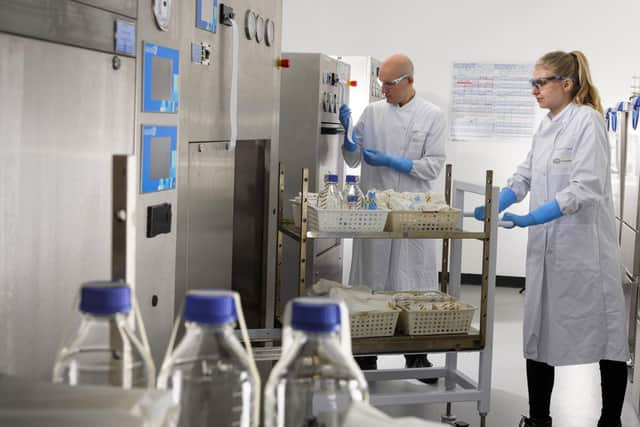
A dedicated team of specialists from Pall Biotech, based at the Harbour Gate facility in North Harbour, have been working flat out to craft a system to safely mass-produce the life-saving drug, which is undergoing clinical trials.
The group is part of a UK-wide consortium of biotech firms, scientists and medical experts, led by Oxford University, seeking to find a cure to the disease, which has killed more than 32,000 in Britain and about 286,000 worldwide.
And in an exclusive interview with The News, a senior director at Pall has admitted if tests of the drug go well, the first large-scale batches could be rolled out in September, with chiefs confident they could produce ‘tens of millions’ of doses by the beginning of next year.

Dr Clive Glover, director of strategy at the international firm, said: ‘The speed with which we’ve worked on this project with all of the consortium members has been quite unprecedented.
‘Usually vaccine development timelines would be measured in years. Now we are talking about this taking place in the space of months.’
A team of 10 scientists have spent months working against the clock in Pall’s North Harbour-based bio laboratory.
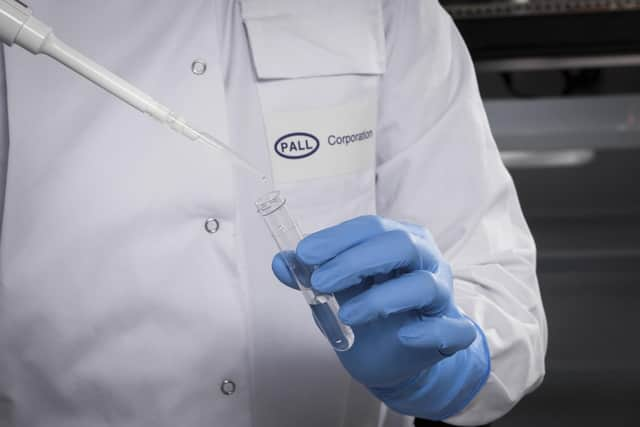
Using their expertise in producing gene therapy drugs, the group has been refining the perfect ‘recipe’ to grow harmless viral ‘vectors’ that can deliver the vaccine safely into the body.
Their mission is to design a manufacturing process that can produce millions of identical doses, safely and effectively.
The work has been supported by staff from Pall’s other facility in Walton Road, Farlington, which is creating equipment needed for mass production.
And Dr Glover has admitted Britain is ‘on track’ to hit its ambitious vaccine target.
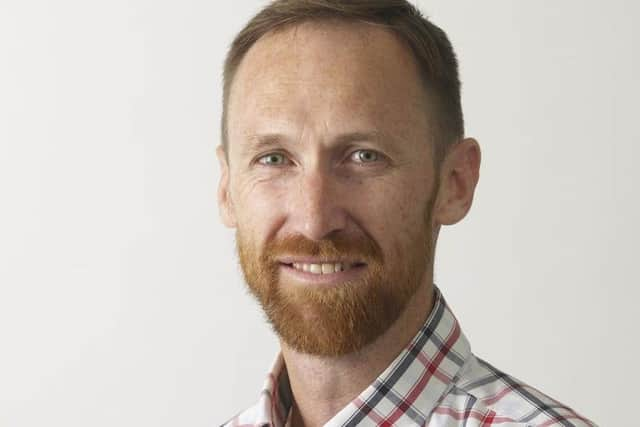
He said: ‘We have a goal within the consortium of having a million doses available by September and then by January 2021 there is a goal to have tens of millions doses available.
‘It is highly dependent on those clinical studies being successful but we’re on track to deliver these ambitious targets.
‘All members of the consortium, including my colleagues at Pall Biotech, have worked admirably and so far the project is going according to plan.’
Penny Mordaunt, Portsmouth North MP, described the health crisis as ‘the challenge of our lives’ and praised Pall for its work developing a coronavirus cure.
‘This work, going on quietly, is what will ultimately beat the virus, and stand us in good stead for whatever may follow it,’ she said.
Manufacturing a vaccine is a complex process involving a number of critical stages.
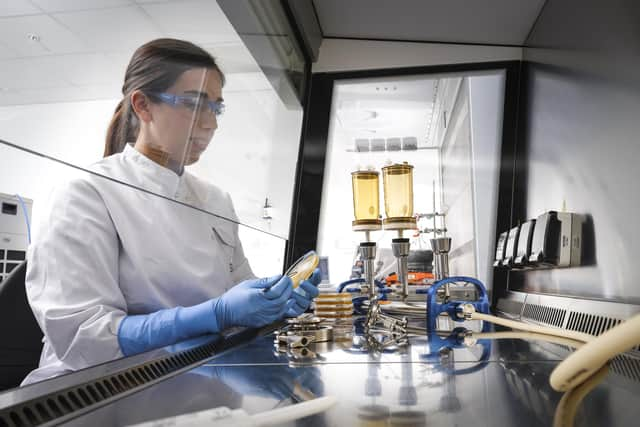
Firstly, a ‘bioreactor’ is used to create enough of the harmless virus that will transport the vaccine into the body.
A complicated purification process is then undertaken to rid any impurities the vaccine may have built up in the bioreactor phase.
Finally, after a series of critical tests and milestones are achieved, the next challenge is to expand the production to a larger scale.
Pall has so far successfully completed two large-scale production runs and is ready to hand over their method to Cobra Biologics, Halix BV and Oxford Biomedica, who will be responsible for mass producing the vaccine.
Dr Glover added Pall facilities in Devon, Cornwall and the Netherlands were also involved in the development.
‘There is definitely a global effort going into this,’ he said. ‘There’s more than 70 different vaccines currently in development and we’re engaged with many of those efforts and are helping others to develop them in a timely fashion.’
On Monday, prime minister Boris Johnson said he was hopeful a cure could be found to the disease and that the UK was at the forefront of work to do so,
But he warned there was ‘no guarantee’ a coronavirus vaccine will ever be found.
Speaking at the Downing Street briefing, he explained: ‘I’m hearing some very encouraging things from what’s going on at Oxford to achieve a vaccine.’
But he added: ‘This is by no means guaranteed. I believe I’m right in saying that even after 18 years we still don’t have a vaccine for Sars. What I can tell you is that the UK is at the forefront of concerted international activity to try to deliver a vaccine.’
Dr Glover said all those involved in the vaccine process were determined to find a cure.
‘This is an incredibly important public health initiative and we have to do whatever it takes to make sure this happens,’ he said.