
University of Portsmouth senior lecturer reveals the social world of spider evolution
WHILE lockdown isolation is still in focus for humans, a new study from the city’s university has revealed that spiders are social creatures which benefit from each other’s company.
The research also highlighted good news for those who are afraid of spiders – the more social they are, the smaller they tend to be. The study of arachnid hunting patterns has found that larger spiders which began to hunt in groups have gradually evolved into smaller species.
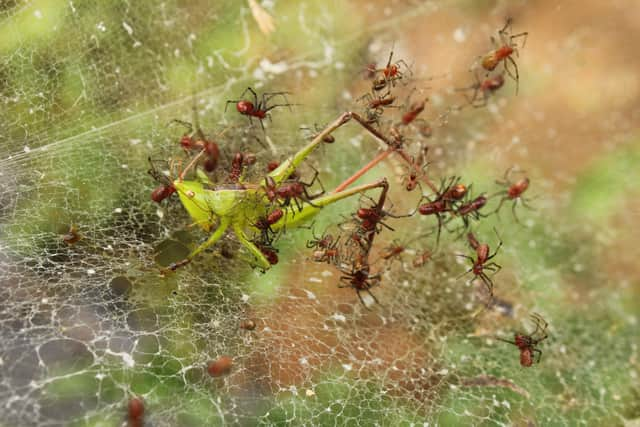

Dr Lena Grinsted, senior lecturer in zoology at the University of Portsmouth, said: ‘Perhaps the most intriguing consequence of this new hypothesis is the suggestion that working together relaxes selection on body size on relatively large spiders.
‘Our argument is that when these spiders start co-operating in catching prey, they can still catch the same really large prey, even if they start to mature at a smaller body size. And a smaller body size carries with it multiple overall fitness benefits when you live in a crowded group.’
The study examined the size ratio of different spider species with the size of their typical insect prey.
Dr Grinsted added: ‘When spiders evolve the ability to catch prey co-operatively, we see a beneficial increase in the prey-predator body size ratio. This increase can be achieved either by catching larger prey, as the classic theory suggests, or by evolving a smaller predator body size, as we see has happened in some social spiders.’
The arachnid expert highlighted the evolutionary benefits of a smaller more social species. These include fewer resources needed for spiders to reach maturity and lower death rates as social spider groups collectively build stronger nests and don’t have to travel long distances for mating – a journey which could potentially leave them exposed to predation.
Dr Grinsted now hopes the hypothesis can be widened to look at the evolution of other species.
‘We welcome further studies testing the predictions generated from our hypothesis, to assess its relevance to other group hunting species,’ she said.