
University of Portsmouth scientists identify ancient flying reptile species on the Isle of Wight
EXPERTS from the city’s university have identified the fossilised remains of a giant flying reptile on the Isle of Wight.
The remains of the pterodactyl, which is more commonly found in China and Brazil, is be believed to be first ever of this particular species to be discovered in the United Kingdom.
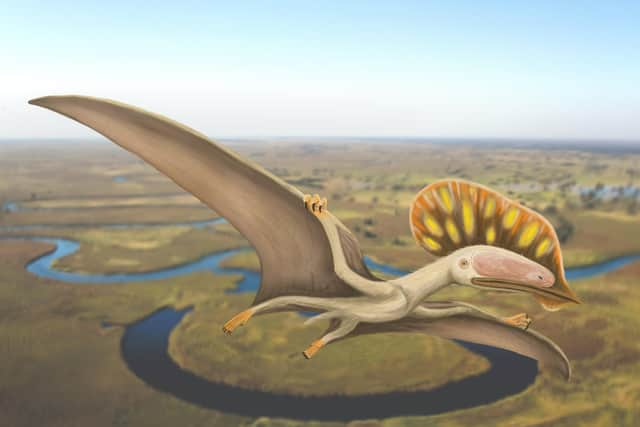

The discovery came when a fossil hunter found ‘a peculiar shaped fragment of fossil bone’ while out walking his dog on the island.
Not sure what it was, he passed it on to University of Portsmouth palaeontology student, Megan Jacobs, who thought it might be the jaw bone from a pterodactyl.
Subsequent research carried out at the university has now identified the creature as part of the tapejarids family – a group of pterosaurs never previously found on these shores.
Megan said: ‘Although only a fragment of jaw, it has all the characteristic of a tapejarid jaw, including numerous tiny little holes that held minute sensory organs for detecting their food, and a downturned, finely pointed beak.
‘Complete examples from Brazil and China show that they had large head crests, with the crest sometime being twice as big as the skull. The crests were probably used in sexual display and may have been brightly coloured.’
Scientists, who have named the new species Wightia declivirostris, have confirmed the remains are more similar to Chinese tapejarids rather than the Brazilian examples.
Professor David Martill, a palaeontologist from the University of Portsmouth, said: ‘This new species adds to the diversity of dinosaurs and other prehistoric reptiles found on the Island, which is now one of the most important places for Cretaceous dinosaurs in the world.’
The finder has kindly donated the specimen to Dinosaur Isle Museum at Sandown, where it will go on display.
Earlier this year a team from the university discovered as similar specimen in Morocco which they named Afrotapejara.