
Jurassic Park: Portsmouth scientist discovers first 'river monster' dinosaur which rips up rule book on ancient hunters
A PORTSMOUTH scientist has helped to rewrite the dinosaur textbooks by discovering the remains of the world’s first ‘river monster’.
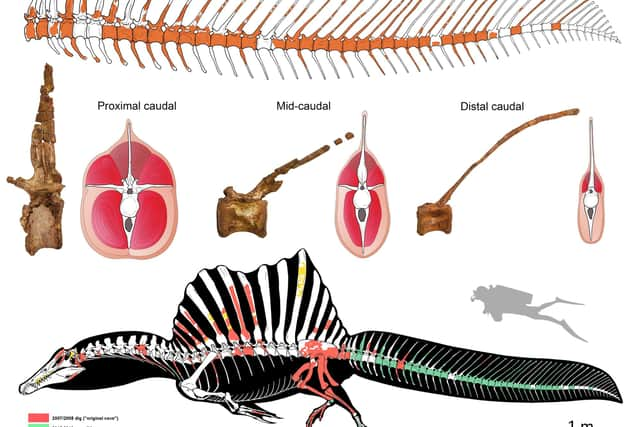
The newly-discovered tail fossil of Spinosaurus aegyptiacus, which was unearthed in southern Morocco, shows the giant predator was a powerful swimmer and the first known to have lived in the water.

The six-tonne predator prowled the rivers that flowed through the Sahara desert 100 million years ago, living and catching its prey in the water, according to the new research.
The study, published in the journal Nature, was carried out by an international team including from the universities of Portsmouth and Leicester.
A University of Portsmouth spokeswoman said: ‘Until now it was believed that dinosaurs lived exclusively on land, but the newly discovered tail of Spinosaurus aegyptiacus, a giant predator, shows that it was actually well adapted to an aquatic lifestyle.
‘The 15-metre-long, six-tonne predator was in fact a powerful swimmer propelled by a huge fin-like tail, which hunted down its prey in vast river systems that flowed through the Sahara desert 100 million years ago.’
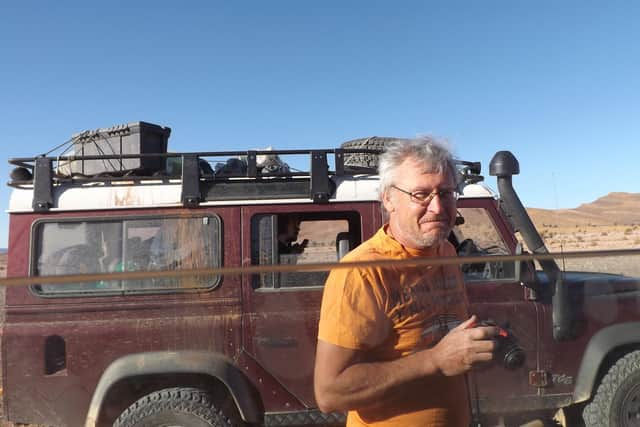
Professor David Martill, professor of palaeobiology at Portsmouth, was part of the team to make the historic discovery.
Speaking to The News, he said: ‘This is phenomenally exciting. It changes everything we thought we knew about dinosaurs.
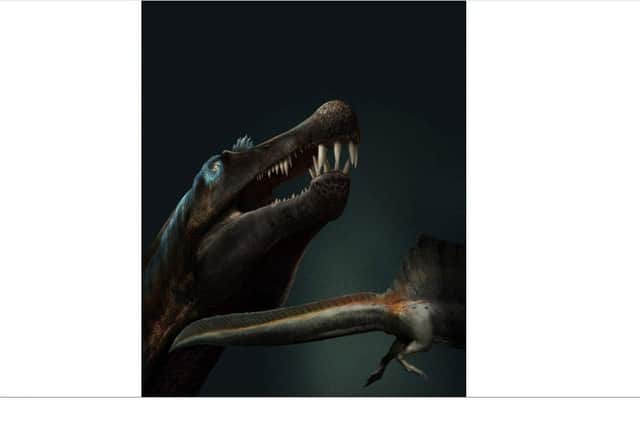
‘The Spinosaurus, as we now know, lived almost exclusively in water and probably only stepped on land to lay its eggs. It’s tail was much like that of a crocodile and meant it was an extremely proficient swimmer.’
Dr David Unwin, reader in palaeobiology at the University of Leicester, added the new information was ground-breaking.
‘The Spinosaurus' fin-like tail is a game-changing discovery for us that fundamentally alters our understanding of how this dinosaur lived and hunted - it was actually a “river-monster”,’ he said.
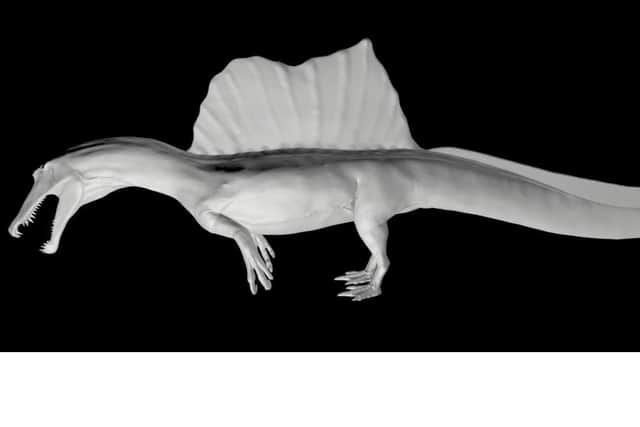
‘As well as its tail, many other features of this dinosaur, such as the high position of the nostrils, heavy bones, short legs, and paddle-like feet point to a life spent in the water rather than on land.
‘Not only did dinosaurs dominate the land and take to the air as birds, they even went back into the water and became the top predators there as well.’
The remains were the first to be found of the Spinosaurus in more than a century.
The previous skeleton of a creature was destroyed during the Second World War.
‘Now we have a new baby to play with,’ added Prof Martill. ‘Every time we look at this dinosaur we discover something fascinating about it. Discovering its tail was such an amazing gift. We had no idea that its tail was going to be so different from other dinosaur tails.
‘One thing that still puzzles me though, is why only Spinosaurus became aquatic among the dinosaurs. Why are there no aquatic iguanodons, or stegosaurs.’
The team recovered about a third of the bones from the Spinosaurus and hope to return to the dig site once more after the coronavirus lockdown.