
Waterlooville man who lost his wife to bowel cancer welcomes research breakthrough
A Waterlooville father who lost his wife to bowel cancer after living with colitis for more than half her life, has welcomed new research which can predict which people with inflammatory bowel disease (IBD) will go on to develop cancer.
Fariba Foster died aged 36, just six months after doctors discovered her cancer during an operation to manage her condition.
Her husband Craig hopes the new method developed by Cancer Research UK's scientists, to identify which IBD patients are likely to develop cancer, will help save the lives of people like Fariba in future.
Craig, who raised £1,700 at Portsmouth’s Race for Life last year to help towards breakthroughs such as this, said: “Research like this will save lives. It gives me comfort to know that there are scientists working right now so that no-one has to experience the same situation Fariba was in.”
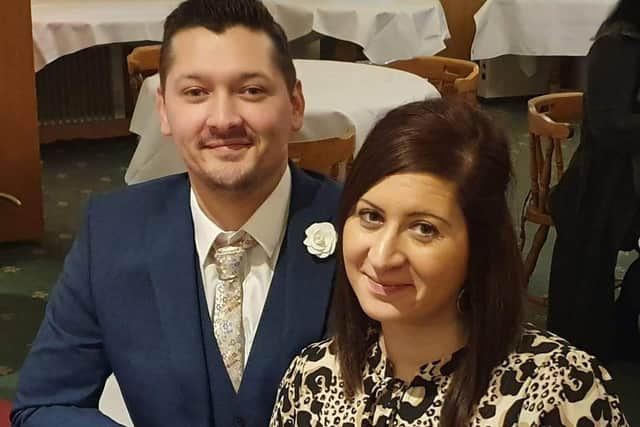

“Cancer takes no prisoners and it doesn’t matter who you are or from what walk of life, everyone is affected in some way. Fariba died just six months after she was diagnosed. Even though it was a short time, it was the worst time. Perhaps if we had been able to predict the likelihood of her developing cancer, it may have saved her life.”
IBD includes ulcerative colitis and Crohn’s disease. They irritate the lining of the bowel, which can cause abnormal pre-cancerous cells to form if left untreated. Having these conditions can increase your risk of bowel cancer, especially if you have had them for several years. According to the charity Crohn’s and Colitis UK, one in 123 (around 500,000 people) in the UK have Crohn’s disease or ulcerative colitis.
In a study published today in the journal Gut, Cancer Research UK-funded scientists at the Institute of Cancer Research (ICR) working with doctors at St Mark’s Hospital, the UK’s specialist bowel hospital, revealed they have developed a method to accurately predict which people with IBD will get cancer.
They found that those whose pre-cancerous cells had lost or gained multiple copies of their DNA, were far more likely to go on to develop bowel cancer. The scientists have created an algorithm that calculates the risk of future bowel cancer, based on the exact pattern of the DNA altered in the pre-cancerous cells.

The team revealed that this method can predict which people with IBD who develop pre-cancerous cells will go on to develop bowel cancer within 5 years with greater than 90% accuracy. This method could be used in hospitals to test for bowel cancer risk in people with IBD in the coming years.
Professor of Genomics and Evolution and Director of the Centre for Evolution and Cancer at the Institute of Cancer Research, London, Professor Trevor Graham, said: “Most people with ulcerative colitis or Crohn’s disease won’t develop bowel cancer. But for those that have these conditions and are showing signs of pre-cancer in their colon, there are some tough decisions to make.
“Do you monitor it regularly, in the hope that it doesn’t become cancer, or do you have your bowel removed to guarantee you don’t get cancer in the future? Neither of these options are particularly pleasant.
“Crohn’s and ulcerative colitis are common and we need better tools to identify the patients at highest risk of bowel cancer. Our test and algorithm give people with IBD, and the doctors who care for them, the best possible information so that they can make the right decision about how to manage their cancer risk. We can accurately identify those people at high risk whilst putting the minds of many others at rest.”
Currently, people with IBD may be offered regular checks for pre-cancerous growths in the lining of the gut. People with the pre-cancerous growths (known as low grade dysplasia or LGD) have around a 30% chance of bowel cancer developing over 10 years. If the patient has LGD, they are classed as high risk and offered treatment to prevent the pre-cancerous cells developing into bowel cancer.
The treatments are bowel removal surgery, which has life-changing side effects such as carrying a stoma bag, or regular monitoring with colonoscopies, which are invasive, time-consuming and cause worry and anxiety for patients because they live with the fear that they may develop bowel cancer in the future.
Craig explained: “Fariba had managed her colitis well since she was diagnosed at the age of 18, when surgeons removed three quarters of her bowel. In the last 18 months of her life though, she’d been having a few issues, so her doctors suggested removing the remaining part of her bowel. It was during that surgery that they discovered she had stage 3 bowel cancer.
“Despite receiving chemotherapy, around Christmas of 2023 we learnt the treatment hadn’t worked and the cancer had spread throughout her abdomen. She sadly passed away at Rowans Hospice in Purbrook last February.
“A large group of us took part in Portsmouth’s Race for Life last summer in her memory and raised thousands of pounds between us to help Cancer Research UK make this kind of progress. I know this kind of breakthrough would make her proud.”
In the study, samples of pre-cancerous cells were taken from 122 patients with IBD. Around half of the patients subsequently went on to develop bowel cancer 5 years after the sample was taken, whilst the other half remained cancer-free after 5 years. All of the samples had their full DNA scanned to look for changes in the structure and number of copies in the DNA. The scientists found that patients with IBD who developed bowel cancer had lost multiple copies of their DNA.
In future studies, the scientists are hoping to develop the test beyond analysing samples of growths taken from the gut to a less invasive method, such as taking a blood sample.
Executive Director of Research and Innovation at Cancer Research UK, Dr Iain Foulkes, said: “Treatment for bowel cancer is far more likely to be effective if you catch the disease earlier. Having Crohn’s or colitis is a known risk for bowel cancer but the risk varies widely between different people, and until now we have had to take a one-size-fits-all approach to preventing it.
“Genome sequencing is now far cheaper and more widespread than ever before, and it’s changing how we look at cancer. Getting a full readout of tumour DNA means we can see a much bigger picture of how someone’s cancer started and how it is likely to change over time.
“With this research, we can focus resources on treating people with IBD who are at really high risk, saving health services valuable time and money. We can also give those at lower risk peace of mind and remove the fear of bowel cancer in the future.”
The research was funded by Cancer Research UK and the Barts Charity. The paper, titled “Aneuploidy burden in low-grade dysplasia strongly predicts colorectal cancer risk in ulcerative colitis”, was published today in Gut.
This year’s Race for Life events in Portsmouth will take place on June 28 and 29 on Southsea Common. If you sign up before Jan 31 using the code RACENY25 people can get 50% off the entry fee.
To enter, visit raceforlife.org