
Spitfire Makers plaque commemorated in Langrish


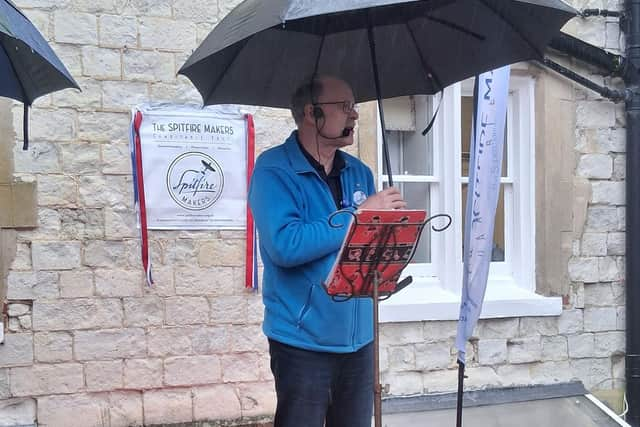
A PRIVATE celebration of The SPITFIRE Aeroplane and those Langrishians who made the parts - 90 years on since its inaugural flight - March 1936 to March 2026 was held at Langrish House near Petersfield on 15 March.
In attendance were Alan Matlock of the Spitfire Makers charitable Trust, who declared this the 21st plaque to be commemorated and the Mayor of Petersfield Cllr Chris Paige.
The Southampton based Spitfire Makers Charitable Trust’s Alan Matlock said; ‘It is the mission of the Trust to locate and commemorate those places in Hampshire which were responsible for ensuring the Spitfires were built, after the bombing of the Supermarine factory in Southampton.’ He will be unveiling the 22nd plaque shortly.
This plaque also commemorates the vital role played by the people of Langrish in the manufacture of parts for the Spitfire which marks this - and other SECRET activity - which took place at Langrish House during World War II. During the speech made by Mr Nigel Talbot Ponsonby many names of village residents were mentioned, whose families still live locally and were present at the unveiling.
IN 1940 Langrish House had been requisitioned by the WAR OFFICE and occupied by New Zealand troops. The house was also the covert base for one of Churchill's clandestine resistance units with underground bunkers hidden deep in the surrounding 'wooded hangers'.
Led locally by Edward Talbot-Ponsonby, the members of No 7 Auxiliary Unit, known as Scallywags, with certain of their number posing as Home Guard, were tasked as a guerrilla force following specialist training to confront what seemed to be an inevitable invasion of England by German troops massing on the other side of the English Channel in German occupied France.
In addition to these covert activities, Edward T-P in the 1930's had established Talbot-Ponsonby & Co Limited, a precision steel die and mould-making works in the stables adjoining Langrish House. The company was soon deep into the war effort sub-contracted to manufacture parts for the Spitfire Aeroplane and munitions. (each bomb produced before despatch from the Works had written on it "made in Langrish!"). Up to 160 men and women were involved working 24 hour shifts at the Works. Langrish-made parts were fitted into some of the more than 20,000 Spitfires built.
Despite the weather there were many local residents and the plaque is now there for everyone to see and appreciate the roles played by so many anonymous workers supporting the fight for peace.
After the unveiling guests were invited for refreshments which of course included the ‘Spitfire’ Beer.