
Warning that Portsmouth Port's taxpayer-funded eco power system ‘could be a redundant asset’
Taxpayer-funded net zero infrastructure at Portsmouth International Port is sitting dormant, it has emerged, with fears its shore power system “could be a redundant asset”.
Mike Sellers, the boss of Portsmouth International Port, has said the situation is partly being caused by Government policies “not quite aligning”, and threatens to “put back the impetus around maritime decarbonisation”.
As previously reported by The News, the port completed its work late last year to enable ferries and cruise ships to switch off their engines and plug into electricity when berthed, to cut carbon emissions and boost air quality.
But the infrastructure has not been used because electricity is four times more expensive than marine fuel, and energy company Scottish and Southern Electricity Networks (SSEN) has not yet connected it to the National Grid.
Ships need power when berthed to run essential onboard systems such as heating, lighting and refrigeration and the Sea Change project to enable ships to plug in at three of the port’s five berths was allocated £19.8 million through the Department for Transport’s Zero Emission Vessels and Infrastructure (Zevi) competition in September 2023. It also received £4.6 million from Portsmouth City Council, which owns the port.
The system was scheduled to be available from spring 2025 but there is now no plan for when it will be used.


Mr Sellers described the circumstances as “incredibly disappointing”.
He said: “The biggest frustration for me is that we’re a demonstration project for maritime decarbonisation.
“We’ve got a three-year period of demonstrating the overall benefits, the air quality improvements, the health benefits.
“Yet there’s a huge risk here this could be a redundant asset.
“We’ve got no guarantee that ships are going to plug in.
“It will put back the impetus around maritime decarbonisation if it’s not practical.
“People will start to be sceptical about it.”
Trade body the British Ports Association has written to Business Secretary Peter Kyle stating it is “growing increasingly alarmed” at the failure of Government policy to “articulate how UK ports can remain competitive as energy costs continue to rise”.
The letter, seen by the Press Association, went on: “Current policy risks simultaneously increasing the cost of maritime decarbonisation while weakening UK port competitiveness.
“As a result, we expect reversals in efforts to decarbonise port operations this year, including a move away from the use of low-emission biofuels and the cancellation or delay of electrification and shore power projects.”
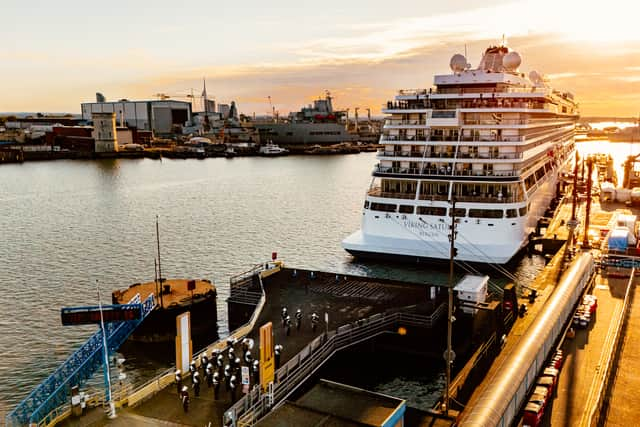
Last year, Portsmouth International Port’s biggest customer, Brittany Ferries, introduced two new hybrid ships that can be plugged in as part of a 550 million euros (£479 million) investment in five vessels. But the vessels are continuing to burn marine fuel when berthed.
A spokesman for the company, which connects Portsmouth with France and Spain, said: “Everything is in place. We have the ships and the port has the infrastructure. The blocker is price.
“We simply can’t plug in our two hybrid ships if it costs around £2.5 million a year more than running engines while alongside in Portsmouth.”
In November last year, the Department for Business and Trade, under the current Labour Government, did not include ports in a consultation on which sectors should benefit from reduced electricity tariffs.
Meanwhile, the Government has announced it intends to incorporate the maritime industry into its Emissions Trading Scheme from July, which will require ships to minimise their carbon emissions or fund measures to offset them. This is part of a UK target for shipping operators to reach net zero for carbon emissions by 2050.
Mr Sellers said: “Government policy is not quite aligning in terms of maritime decarbonisation.
“You’ve got ETS being introduced to penalise ships for not being clean
“We’re putting in shore power, but the cost of electricity is at a scale that’s so high that it’s far too expensive for the ships to actually plug in.”
He said ships are not mandated to use shore power, and the financial impact of ETS will be lower than switching to electricity, so operators have “the option to pay to pollute rather than decarbonise”.

A Government spokesperson said: “We’re investing nearly £20 million in Portsmouth International Port’s Sea Change project, helping ships use clean shore power and improve local air quality.
“We recognise that the port has been waiting for an upgraded grid connection before shore power can be used.
“We are working with (energy regulator) Ofgem exploring measures to make connections faster and easier for customers across the country.”
Spring 2025 was the initial deadline for SSEN Distribution to complete the electrical connection to the site, but this is now expected to be done by April 2026.
A spokesperson for the company said: “We’re working closely and constructively with the team at Portsmouth Port to finish works to connect their upgraded facilities to the distribution network, and we look forward to the project’s completion.”