
Two Portsmouth residents set to appear in photography exhibition, celebrating stories of blind and partially sighted people
A braille artist and an astronomer – both residents of Portsmouth – are set to appear in a new portrait exhibition this September, spotlighting the strength, individuality and lived experiences of blind and partially sighted people across the UK.
Known for his pioneering use of colour-coded Braille as a visual language, local artist Clarke Reynolds (also known as ‘Mr Dot’) and Dr Nicolas Bonne, a visually impaired astronomer and outreach and public engagement officer of University of Portsmouth will both appear as subjects in a soon to launch photography exhibition.
Acclaimed photojournalist and portrait photographer, Joshua Bratt is responsible for this powerful exhibition, titled Seen, which can be viewed at the RNIB Grimaldi Building in London. It will feature 22 intimate photographic portraits that share interesting stories of people who navigate the world with sight loss. Bratt’s thoughtful composition invites audiences to see the person beyond the sight loss, placing their achievements, passions and inner worlds front and centre.
Bratt found inspiration for Seen when he noticed a cane user during his regular commute to Central London. He commented: “Ignorantly, I would just see him as a blind person rather than a man going to work with a job and a story, and I realised that if I was subconsciously labelling somebody, and just seeing the disability rather than who they were as a person, then other people were likely doing that too.”

He continued: “I came up with the idea of going around the country and finding blind or partially sighted people with interesting backgrounds and stories to and taking their picture to help change the perceptions that many people may have about sight loss.”
Bratt connected with RNIB to support him in sourcing subjects for his shoots. Following a call out on its social media channels, Louise Simpson, the first blind person to reach the 100 Club of Marathons, became the first ‘sitter’ in this project. Momentum built quickly after this, and soon many famous faces joined the body of work, including; politician and former Home Secretary, Lord Blunkett, British Archery Champion, Clive Jones, barrister Jessika Inaba, model Nan M, artist Clarke Reynolds and Astronomer Dr Nicolas Bonne,
Having gradually lost his sight, Clarke Reynolds took to art to redefine what it meant to communicate through creativity. His practice invites audiences to engage with art not just by seeing, but through touch, interpretation, and emotion.
For his portrait, Clarke chose to be photographed in his art studio wearing his iconic yellow dungarees, a visual statement of both visibility and optimism. He felt the location sent a clear and powerful message that being blind does not limit professional ambition. “The studio is where the magic happens,” Clarke says. “It’s where I turn dots into stories. It’s where my blindness isn’t a limitation – it’s a superpower.”
Clarke hopes visitors to the Seen exhibition will leave feeling inspired, challenged, and uplifted. He adds “I want people to see blindness not as a deficit, but as a different way of understanding and contributing to the world – one that has value, creativity, and professionalism at its heart”.
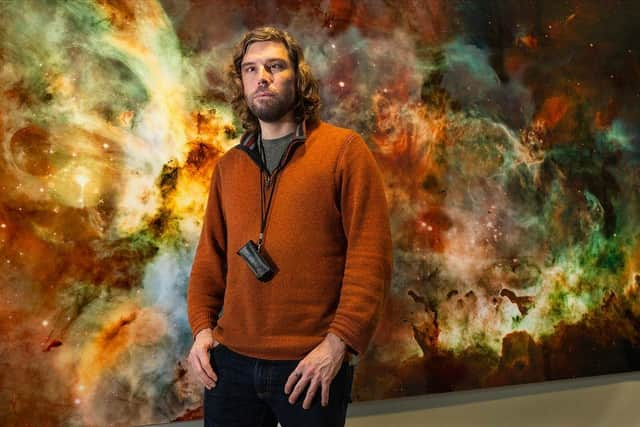
Originally from Australia, Dr Bonne had a severe vision impairment from birth due to an eye condition called retinopathy of prematurity. Even though he couldn’t experience the clear Australian night skies in the same way as his friends and family, he has always been fascinated by space and decided to become an astronomer at a young age. After completing his PhD, he moved to the UK to start his career as a professional astronomer and now works at the University of Portsmouth’s Institute of Cosmology and Gravitation. Most of his work involves leading the Tactile Universe Project, where his team are developing multi-sensory resources (like tactile images of space) to give blind and partially sighted people more ways of accessing some of the really visual parts of astronomy.
Dr Bonne’s portrait was taken at the University of Portsmouth, with the backdrop featuring a Hubble Space Telescope image of a small section of the Carina Nebula - a vast cloud of dust and gas that contains thousands of stars. Dr Bonne comments “I hope that after attending this exhibition, visitors will come away understanding that, with determination and sometimes some clever problem solving, blind and partially sighted people can achieve anything they set their minds to”
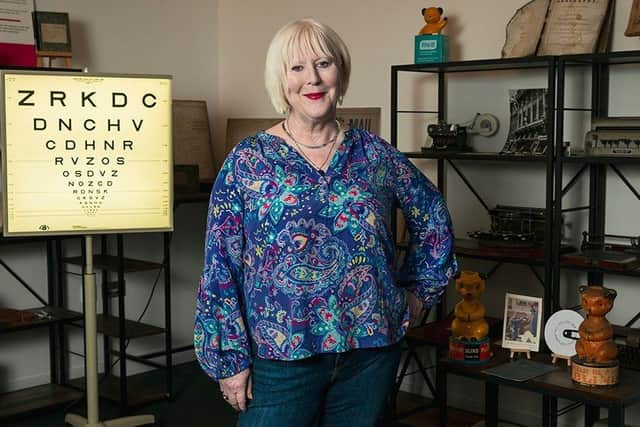
Anna Tylor, Chair of RNIB, was also photographed as part of the project. She said: “It was a pleasure to be part of the amazing line up of people in Joshua’s project. His work is a moving reminder that representation matters - not only in how people are seen, but in how we are heard, felt, and understood. RNIB is thrilled to open its headquarters to this exhibition, and we hope people enjoy experiencing a glimpse of some of the amazing stories behind the talent that feature in this photo series.”
The free-to-view exhibition has been curated with accessibility at its core. Each portrait will be accompanied by rich audio descriptions while a tactile brochure will be available so people can experience the images through their sense of touch. The exhibition will run from Friday 12 to Sunday 14 September 2025 at RNIB’s Grimaldi Building, 154a Pentonville Road, London, N1 9JE. Timed viewing slots can be booked for free at Evenbrite.co.uk
For more information or to view the works online, visit rnib.org.uk/bookseen