
Review | 'Mark Hadfield's Poirot lifts the whole production': Death on The Nile at Chichester Festival Theatre
It might sound paradoxical – but there can be something quite comforting about a whodunnit.
Take the coziness of a period drama and add a dash of mystery, a pinch of glamour and a couple of frights and you have that tried and tested formula that keeps us coming back for more.
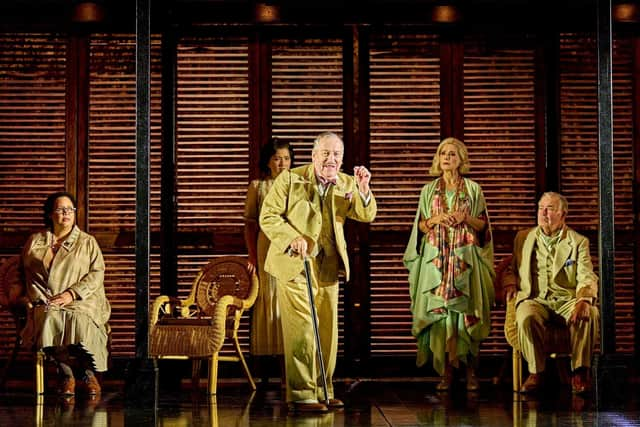

It’s a recipe for success that catapulted Dame Agatha Christie to the upper echelon of crime writers and millions of books sold, with myriad television and film adaptations.
Arguably her second best-known story behind a certain doomed train, Death on the Nile tells the tale of the murder of Linnet Ridgeway, a wealthy if morally dubious heiress shot to death on board the SS Karnak, a steamer cruising along the Egyptian river.
But to the murderer’s misfortune, one of the passengers on board happens to be a certain Hercule Poirot.
The original book has a whole menagerie of colourful characters, trimmed down in this adaptation by Ken Ludwig and brought to life by Lucy Bailey.
We spend the first act being introduced to them: the eccentric novelist Salome Otterbourne, theatre doyen Septimus Troy and eminent Egyptologist Atticus Praed among others, all with a motive to kill Linnet.
The latter features in a poisonous love triangle with her newly-married husband Simon Doyle and the woman he jilted: Jacqueline de Bellefort, Linnet’s former best friend who seems determined to make them pay for breaking her heart.
Despite the cast being pared down to the key players, the first act’s pacing is in fact a little slow and loses the colour these supporting characters provide, with some of the acting a tad overwrought yet the motives for killing feeling muted.
But Olivier nominee Mark Hadfield as Poirot is a top-notch performance and lifts the whole production: funny, commanding and familiar enough to stand alongside the great portrayals without seeming like a caricature of them.
Things certainly pick up the pace following Linnet’s death in the second act, with murder weapons being discovered and the puzzle being pieced together with the help of the Belgian’s little grey cells before the familiar denouement: the revelation of the murderer by Poirot with all the suspects gathered around.
In this case, fine-tuning the story by trimming out some of the extra murders actually gives focus and helps speed matters along, and the flashbacks showing how the crime was committed were polished.
Without spoiling the ending, I heard some punters say they had no idea it was coming as we left the theatre, which counts for something.
As Death on the Nile adaptations go I think my favourite is still the 1978 star-studded film, but the gunshots in this were certainly more immediate.
Perhaps murder mysteries are not as comforting as I first thought.
Until January 31.